
AI technology is advancing at extraordinary speed. New models, platforms and capabilities are emerging almost weekly, creating opportunities for businesses to rethink how they operate.
Yet for many enterprises, turning that potential into measurable financial returns remains a significant challenge.
This was the central theme of The Enterprise AI No Man's Land: Who Takes the Ground and Who Holds It?, a keynote delivered by Tenth Revolution Group Chief Operating Officer Mark Hill at AI Summit Barcelona 2026.
Held at the World Trade Center Barcelona on September 22–23 and attended by Tenth Revolution Group as Gold Sponsor, the event brought together technology leaders, innovators and enterprise decision-makers to explore the next phase of AI adoption.
Our keynote explored the growing gap between what AI technology can achieve and what businesses are successfully implementing, and why a new generation of engineering expertise could be critical to closing it.
The AI value conundrum: Time saved versus money made
Businesses have already seen how AI can accelerate tasks, improve productivity and reduce manual work.
But saving time doesn't automatically translate into measurable financial returns.
For enterprise leaders, the real challenge is demonstrating how AI investment contributes to revenue growth, cost reduction or improvements to the bottom line.
While productivity gains provide an encouraging starting point, realizing their full value often requires changes to the way work is organized and delivered.
An AI tool might help an employee complete a task in half the time, but unless that efficiency translates into increased output, reduced costs or additional business value, the financial impact can remain difficult to quantify.
This is one reason agentic AI is attracting so much attention.
AI agents have the potential to go beyond supporting individual tasks and take on more complex activities across business workflows. That creates opportunities to automate processes, improve operational efficiency and deliver more substantial returns.
However, capturing that value requires organizations to rethink how AI fits into their operations.
The focus needs to shift from demonstrating what AI can do to identifying where it can create measurable commercial impact.
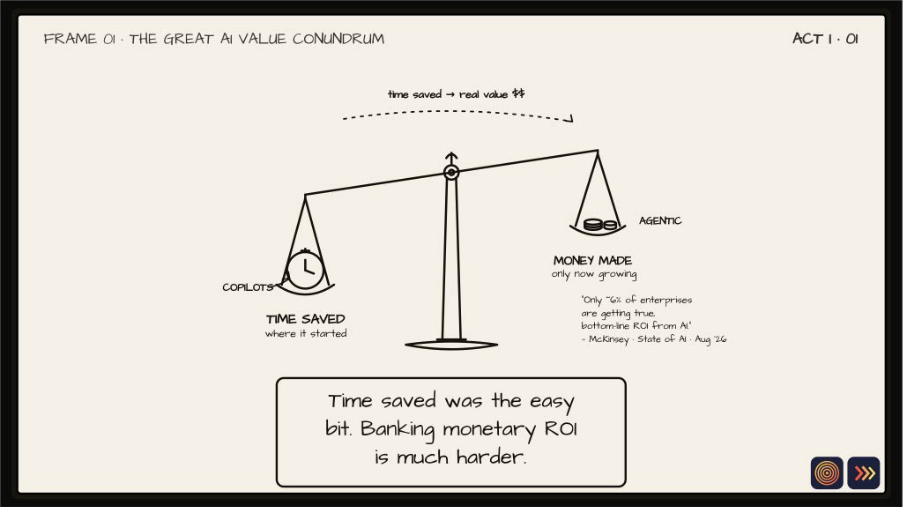 Moving from AI-driven productivity gains to measurable financial returns remains a central challenge for enterprises.
Why enterprise AI adoption is proving so difficult
Enterprise technology environments are complex by design.
Organizations have spent decades building systems, processes and operating models that support their operations. Introducing AI into these environments often means challenging established ways of working.
Legacy technology, regulation, data quality, governance requirements and organizational structures can all create barriers to adoption.
But one of the biggest challenges is people.
Employees have different expectations and concerns about AI. Some see opportunities to improve productivity and develop new capabilities, while others worry about job security, accountability or losing control over familiar processes.
Leadership teams face equally difficult questions.
Who is responsible when an AI agent makes a mistake? How should organizations manage security and governance? Which processes should be redesigned, and who has the authority to make those decisions?
At the same time, increasingly accessible AI tools allow employees and departments to experiment independently, sometimes without the oversight or technical expertise required for enterprise deployment.
This creates opportunities for innovation, but it also introduces risks around shadow AI, fragmented adoption and inconsistent governance.
For organizations to make meaningful progress, technical implementation needs to be accompanied by effective change management, clear ownership and a workforce equipped to operate in an AI-enabled environment.
The technology may be ready, but businesses must also be ready to change.
The enterprise AI no man's land
A race is underway to establish AI within the enterprise.
On one side are technology vendors, AI labs, cloud providers and enterprise software platforms, all competing to bring their capabilities into business environments.
On the other are enterprises facing pressure to adopt AI, improve efficiency and remain competitive.
And behind both is growing scrutiny from CFOs and investors who want to see returns on AI investment.
Between these competing forces lies what we call the enterprise AI no man's land.
It's the space between the AI capabilities available in the market and the ability of organizations to implement them effectively.
Technology providers are pushing innovation forward, while businesses are pulling new capabilities into their operations.
But neither side can close the gap through technology alone.
Successful implementation requires people who can understand business challenges, navigate enterprise complexity and translate emerging AI capabilities into solutions that deliver results.
The organizations that make the most progress will be those that can bring these capabilities together and establish a clear route from AI opportunity to production.
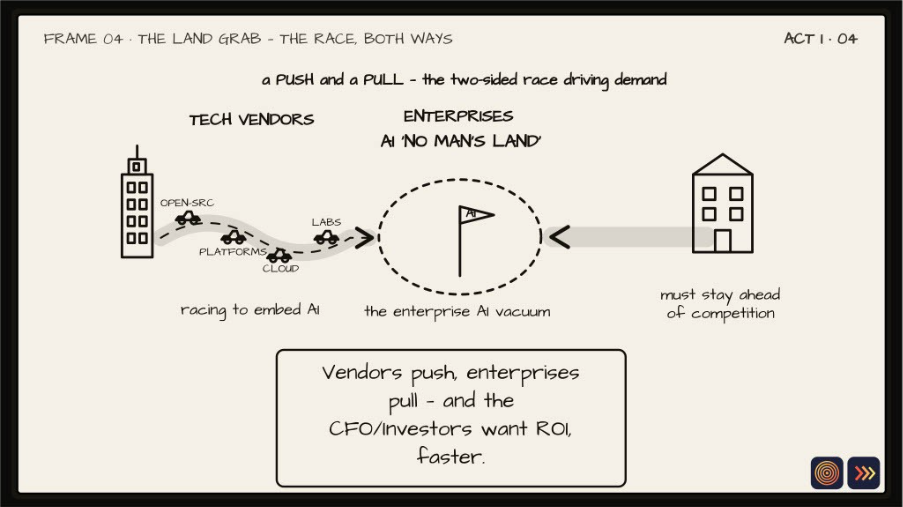
Technology vendors are pushing AI into the enterprise while businesses are pulling new capabilities into their operations, creating a race to turn innovation into value.
Forward Deployed Engineers: Bridging the gap between AI ambition and delivery
As businesses look for ways to accelerate AI adoption, Forward Deployed Engineers (FDEs) are becoming increasingly important.
Originally associated with Palantir, the FDE model places highly capable engineers directly alongside customer teams to solve complex, real-world challenges.
What distinguishes a true FDE is the combination of deep technical expertise and a strong understanding of business needs.
Traditional engineering roles may focus primarily on building technology, while consulting roles often concentrate on business strategy, requirements and stakeholder engagement.
Forward Deployed Engineers bring these capabilities together.
They can identify valuable AI opportunities, develop the business case, design and build solutions, navigate technical constraints and take ownership of getting those solutions into production.
Their role requires a distinctive combination of skills:
- Deep engineering expertise: The ability to build, integrate and deploy production-ready AI solutions
- Commercial understanding: Recognizing which business problems are worth solving and how success should be measured
- Customer focus: Working closely with stakeholders to understand their processes, priorities and challenges
- Ownership and adaptability: Taking responsibility for delivery and navigating complex or ambiguous environments
- Communication and influence: Building confidence among technical teams, business leaders and decision-makers
These capabilities are particularly valuable when organizations need to move quickly from an initial use case to a working solution.
However, as demand for FDEs grows, businesses must look beyond job titles.
Not every AI engineer or technical consultant has the combination of skills required to operate effectively in a forward deployed role.
Identifying professionals with genuine engineering depth, commercial awareness and hands-on delivery experience is essential.
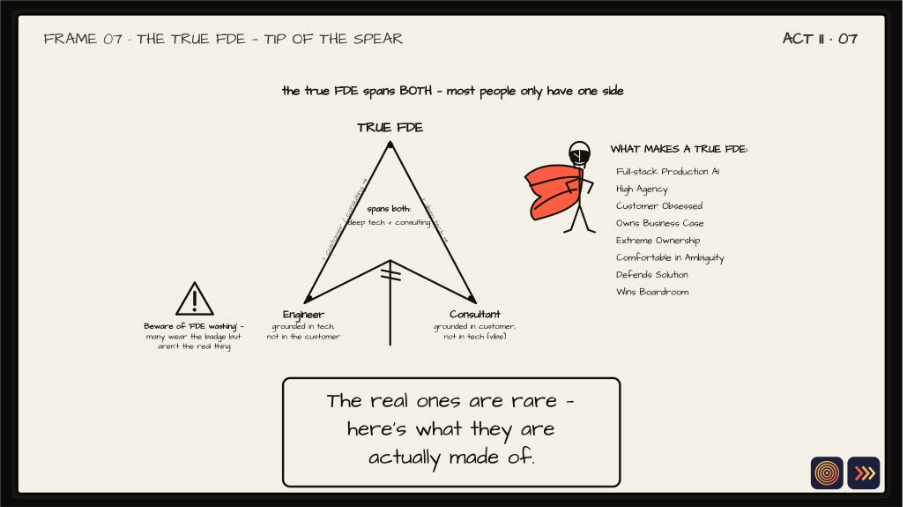 Forward Deployed Engineers combine technical depth, customer understanding and commercial ownership to move AI solutions into production.
Why enterprise AI delivery often requires a team
While individual Forward Deployed Engineers can make a significant impact, complex enterprise projects frequently require a broader combination of expertise.
Implementing AI successfully involves technical development, commercial planning, stakeholder engagement and organizational change.
A multidisciplinary Forward Deployed Engineering squad can bring these capabilities together.
At the center is the FDE, responsible for building and deploying the solution.
Working alongside them, an AI strategist can help identify valuable use cases, develop the business case and secure leadership support.
An adoption specialist can focus on preparing employees, redesigning workflows and helping teams embrace new ways of working.
These core roles may be supported by specialists in engineering, security, data governance and other disciplines, depending on the requirements of the project.
This approach helps organizations address the challenges of AI implementation from several directions simultaneously.
Technical development can progress alongside business planning and workforce preparation, reducing the risk of solutions reaching production without the support needed for successful adoption.
It also allows businesses to access specialist expertise without necessarily building every capability internally from the outset.
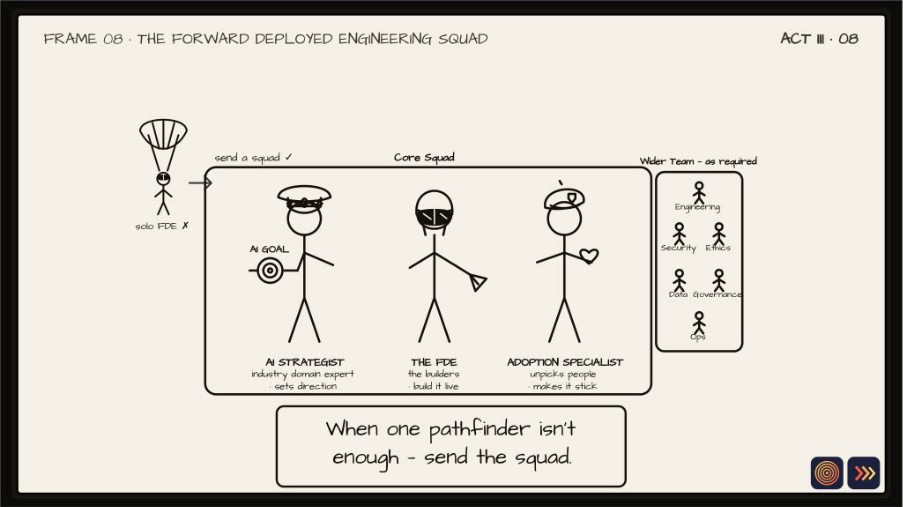 An FDE-led squad brings together engineering, strategy and adoption expertise to address the technical and organizational challenges of AI implementation.
Getting AI into production is only the beginning
Moving an AI solution into production is a major milestone, but it's only one stage of the journey.
Once a solution is live, organizations need to maintain its performance, manage risk and adapt it to changing requirements.
Models evolve, business processes change and new governance considerations emerge.
Solutions developed for a specific use case may also require further engineering before they can be deployed more widely.
This creates an important distinction between the expertise needed to establish an AI capability and the teams responsible for sustaining it.
Forward Deployed Engineers and their supporting squads can accelerate the initial implementation, establishing working solutions and overcoming early barriers.
Longer-term ownership then needs to transition to teams equipped to operate, maintain and scale those capabilities.
These teams may include AI engineers, platform specialists, security professionals, governance experts and operational support functions.
The handover is critical.
Without a clear plan for ongoing ownership, organizations risk creating AI solutions that demonstrate early promise but struggle to deliver sustainable value.
A successful AI strategy therefore needs to consider both deployment and long-term operation from the beginning.
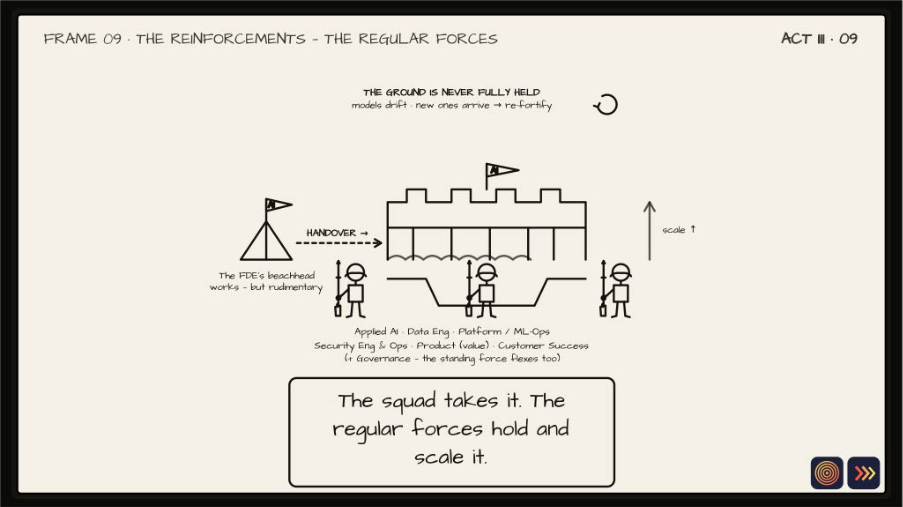 Successful AI adoption requires both the specialist teams that establish solutions and the operational expertise needed to sustain and scale them.
What enterprise AI adoption looks like in practice
These challenges are already shaping how major organizations build their AI capabilities.
During our keynote at AI Summit Barcelona, we were joined on stage by Juan Antonio Buero, Head of AI for Commerce at BASF, who shared his experience of implementing AI solutions within a large enterprise.
The discussion highlighted the importance of both workforce adoption and access to specialist technical expertise.
As organizations introduce AI, employees need support to adapt their workflows and embrace new capabilities.
At the same time, businesses need professionals who can combine engineering skills with an understanding of how their operations work.
BASF's approach illustrates how internal capability and external expertise can complement one another.
While the organization has developed an internal AI engineering team, it also draws on external specialists in areas such as security, governance and agent operations.
These specialists help establish capabilities, support internal teams and transfer knowledge so the organization can continue developing its AI operations.
The discussion also highlighted the growing importance of professionals who can challenge existing processes and identify opportunities to redesign workflows around AI.
As adoption matures, enterprise teams are likely to become increasingly hybrid, combining human expertise with AI agents across a wider range of activities.
For businesses, this reinforces the need to think beyond individual AI tools and consider the people, processes and operating models required to support them.
Building the capabilities enterprises need to succeed with AI
The rapid development of AI is changing the skills organizations need.
Forward Deployed Engineers are emerging as an important part of this landscape, but they're only one element of a broader capability requirement.
Businesses also need AI strategists, experienced engineers, governance specialists, adoption professionals and operational teams capable of sustaining production systems.
Finding these skills is challenging, particularly when organizations need professionals who can combine technical expertise with practical business understanding.
And as AI continues to evolve, the structure of enterprise AI teams will need to evolve alongside it.
Organizations must consider how to access specialist expertise quickly, develop internal capabilities and establish delivery models that support both immediate priorities and long-term growth.
At Tenth Revolution Group, we bring these requirements together through our connected Talent, Training and Transformation services.
Our specialist talent expertise helps organizations find and access hard-to-source technology professionals, while our training capabilities support the development of practical, in-demand skills.
Whether organizations need individual specialists, structured skills development or support delivering complex AI projects, our approach connects the people and expertise required to move forward.
Who takes the ground, and who holds it?
The pace of AI innovation shows little sign of slowing.
As technology providers continue introducing new capabilities, businesses will face growing pressure to translate those developments into operational improvements and measurable financial returns.
Closing the enterprise AI no man's land will require more than access to advanced models and platforms.
It will require professionals who can identify valuable opportunities, navigate enterprise complexity and build solutions that work in real business environments.
Forward Deployed Engineers can help organizations establish that initial capability, supported by multidisciplinary teams that address the commercial, technical and human challenges of implementation.
Equally important are the people who maintain, govern and scale those solutions over time.
The businesses that succeed will be those that can bring these capabilities together, turning AI investment into lasting operational and commercial value.
At Tenth Revolution Group, we're helping organizations build the talent, skills and delivery capabilities needed to make that happen.